
In Math we are learning to;
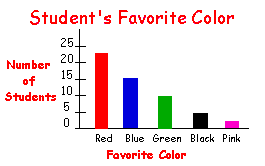
• collect and organize categorical or discrete primary data and display the data using charts and graphs, including vertical and horizontal bar graphs, with labels ordered appropriately along horizontal axes, as needed;
• read, describe, and interpret primary data presented in charts and graphs, including vertical and horizontal bar graphs.
AT HOME:
Learning to collect, organize, and interpret data at an early age will help children manage and interpret information, and use the critical thinking skills they have mastered to make sound decisions.
At home you can;
What are all the different ways in which to sort groceries? Sort household items.
Show your child how you organize food items in the fridge – fruit together, vegetables together, drinks on one shelf, condiments on another.
As your child tidies up toys or clothing, discuss which items should go together and why.
Encourage your child to sort other household items – crayons by colour, cutlery by type or shape, coins by denomination.
Make this task more challenging by sorting according to two attributes. For example, put together all the coins that have a value of less than a dollar and have a value represented by an even number.
Are there more sunny days than rainy days? Have your child draw pictures on a calendar to record each day’s weather. At the end of the month, make a picture graph showing how many sunny days, cloudy days, and rainy days there were in that month.
In which month are most people born? Create a graph to record the birthday month of each person your child knows. Are there months that are not represented in your graph? Which season has the most or least birthdays?
What words are useful in describing how likely something is to occur? Have your child draw pictures of things your family does often, things you do sometimes, and things you never do.Discuss why you never do some things (swim outside in January). Ask your child if it’s likely to rain today. Is it likely that a pig will fly through the kitchen window?
When a coin is flipped,which is more likely, heads or tails? Have your child predict whether a coin will show a head or a tail when it is flipped.Together, record your results over 10 flips, and compare the results with the prediction.
Then flip the coin 10 more times. Are the results the same? Would they be the same if you flipped the coins 100 more times?

No comments:
Post a Comment
Note: Only a member of this blog may post a comment.